


Every AI provider in Europe now calls itself sovereign. But only a few of them are.
Some mean their servers are in Frankfurt. Some mean they signed a GDPR data processing agreement. Some mean their requests stay in Europe, until capacity runs out. None of that, on its own, is sovereignty. Here is what the word actually requires, and how to tell the difference.
Sovereign AI is AI infrastructure where every request, every token and every response stays under one legal jurisdiction. For a European company, that means three things at once: the model runs in data centres inside the EU or EEA, every company that operates or controls the service is European, and requests never leave Europe, not even when something fails.
Key facts
- Data residency alone doesn't protect you from the US CLOUD Act. The CLOUD Act follows the company, not the server.
- The EU now measures sovereignty officially. The European Commission's Cloud Sovereignty Framework rates cloud providers from SEAL-0 to SEAL-4, and the proposed Cloud and AI Development Act (June 2026) introduces four Union assurance levels.
- Closed models can be switched off from outside Europe. In June 2026, one US directive took two Anthropic models offline worldwide.
- Open-weight models make sovereign AI practical. Models such as GLM, DeepSeek, Qwen and Mistral Small can run entirely on European infrastructure.
Two meanings of "sovereign AI"
For countries, sovereign AI means a nation's ability to build and run AI with its own infrastructure, data, talent and companies. This is the definition NVIDIA popularised. For companies, it means something more concrete: the AI services you use stay under the jurisdiction you choose. This guide is about the second meaning.
Data residency vs. data sovereignty vs. sovereign AI
These terms get mixed up in marketing, but they describe different things.
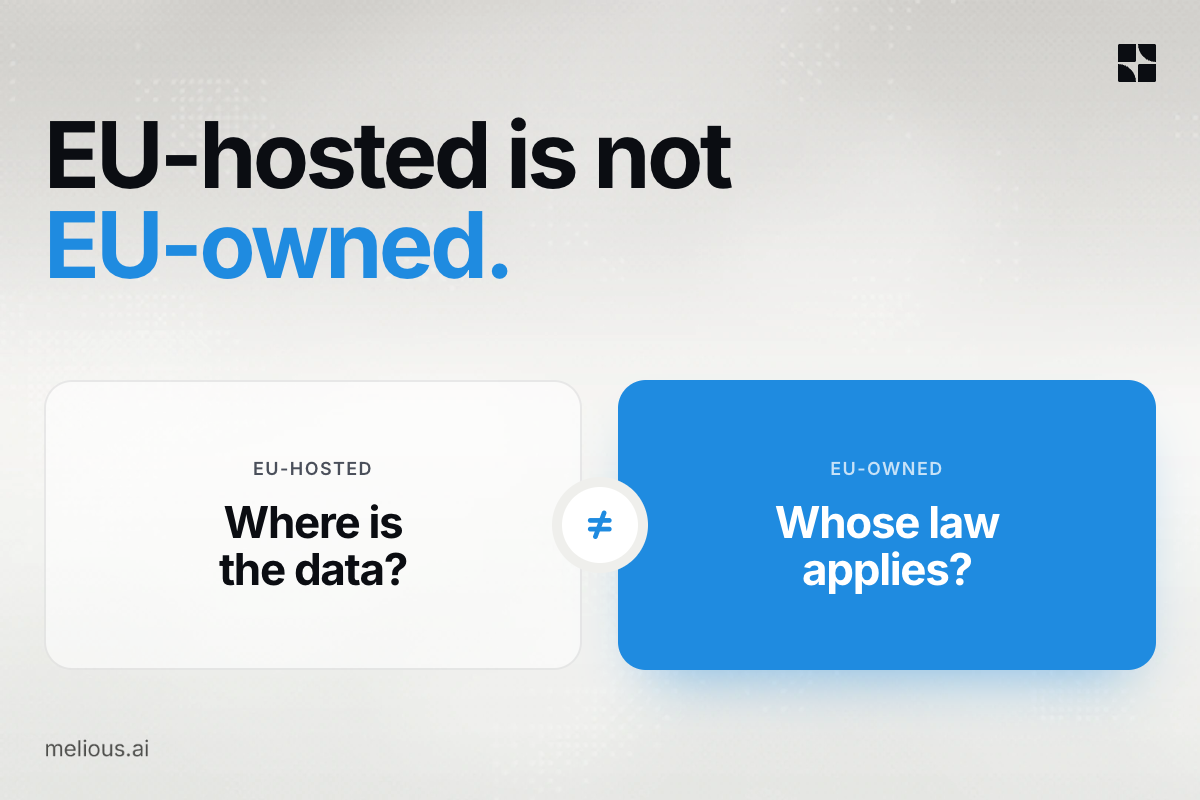
Data residency answers one question: where is the data stored and processed? An EU region of a US cloud provider gives you data residency. It does not protect you from the CLOUD Act, because the company running that region is still American.
Data sovereignty goes a step further and asks whose law applies to the data. A European provider with no non-European parent gives you data sovereignty.
Sovereign AI covers both, and adds two things that matter specifically for AI: where your requests go when something fails, and whether someone outside Europe can cut off access to the model.
If your DPO asks "can this request ever end up outside Europe, or in the hands of a non-European company?", data residency often answers "probably not". Sovereign AI answers "no". We go deeper on the jurisdiction question in EU-hosted vs. EU-owned.
Why sovereign AI matters for European companies
The CLOUD Act and foreign government access
The US Clarifying Lawful Overseas Use of Data Act (CLOUD Act) lets US authorities compel providers under US jurisdiction to hand over data in their possession, custody or control, even when that data is stored on European servers. If your AI provider is a US company, or a European company owned by one, the CLOUD Act can apply. A European data processing agreement does not override it.
A provider that is European all the way up, with no US parent, no US presence of its own and no US sub-processors, is generally outside its reach. The details are in The Data Privacy Framework holds. That is not the same as safe.
GDPR and international transfers
Personal data may only leave the EU under an adequacy decision, such as the EU-US Data Privacy Framework, or with safeguards such as Standard Contractual Clauses. The European Court of Justice has struck down two earlier EU-US frameworks, and the current one is being challenged again. Keeping data in Europe takes that uncertainty off the table.
The off-switch
Access to a model can be cut by a decision made outside Europe. In June 2026, a single US export-control directive took Anthropic's Fable 5 and Mythos 5 offline for customers worldwide, from one day to the next. We wrote about it in The Fable 5 shutdown and who holds the off-switch.
How the EU defines sovereignty: SEAL levels and the Cloud and AI Development Act
Until recently, "sovereign" was a marketing word. The EU is now turning it into something you can measure.
The Cloud Sovereignty Framework. The European Commission uses this framework to assess cloud providers in its own procurement. It rates providers on eight sovereignty objectives, including legal and jurisdictional exposure, data and AI, operations and supply chain. Each objective gets a level from SEAL-0 (no sovereignty) to SEAL-4 (full digital sovereignty, with no critical non-EU dependencies). A provider's overall level is its weakest one.
The Cloud and AI Development Act (CADA). The Commission proposed this regulation on 3 June 2026 as part of its Tech Sovereignty Package. It introduces four Union assurance levels. Level 1 only requires that data is processed and stored in infrastructure located in the EU. Level 2 adds independence from third countries and transparency over the software supply chain. Level 3 requires that the provider is owned and controlled from the EU, with additional criteria such as personnel citizenship. Level 4 requires full transparency and control over the software supply chain, and no interference from a third country.
CADA is still a proposal, and its assurance levels are meant for public sector bodies first. But the logic is the same one this guide follows: location is only level 1, and real sovereignty starts with ownership and control.
What sovereign AI requires
Not every provider that claims European AI is sovereign. Ask these five questions:
- Where is the hardware? Inference runs only in data centres in the EU or EEA. No US or APAC regions, no hybrid setups.
- Who owns the provider? The company you sign with is established in Europe, and so is its parent. A European GmbH that belongs to a US corporation can still be reached by US law, as we showed in The German GmbH That Belongs to Delaware.
- Who are the sub-processors? Every company that handles your requests, including inference and cloud partners, is European.
- Where do requests go on failover? To another European location, never outside the jurisdiction.
- What happens to your content? No training on your prompts or responses, confirmed in writing, and no logging of content. Only operational metadata, such as request ID, token counts, model and cost.
If a provider can't answer one of these clearly, treat that as a warning sign.
Are the hyperscalers' sovereign clouds sovereign AI?
The large US cloud providers have answered European concerns with dedicated offerings, such as the AWS European Sovereign Cloud in Brandenburg, Microsoft's EU Data Boundary and Google's partnership with Thales in S3NS.
These offerings reduce the risk of data leaving Europe through day-to-day operations, and for moderate requirements they may be enough. But their parent companies are still US corporations, and none of them claims full legal immunity from US orders. They solve location and much of operations, but not ownership. They narrow the gap between EU-hosted and sovereign without closing it.
Sovereign AI and open-weight models
Sovereign AI does not mean closed or proprietary. In practice, it works best with open-weight models, whose weights anyone can download.
A closed model like GPT-5 or Claude only runs where its maker allows it, on its own servers or those of licensed cloud partners. So its maker decides who can use it, where and for how long. An open-weight model such as GLM, DeepSeek, Qwen or Mistral Small can run on any hardware, including European hardware run by European companies. Once the weights are on that hardware, nobody can take them back, change them without notice or switch them off for your region.
Open weights don't make a model safe or compliant by themselves. But they remove the dependency on a single company in a single jurisdiction. And since most providers serve them through OpenAI- or Anthropic-compatible APIs, switching is usually a matter of changing the base URL, as we show in How to switch from a US AI provider to EU inference.
Who needs sovereign AI?
Not every workload requires it. If you're building a consumer chatbot with no personal data, a US provider may be fine.
Sovereign AI is the safe choice if you:
- process customer or employee data with AI
- build internal tools that touch contracts, financials or source code
- work in a regulated industry, such as finance, healthcare, legal or the public sector
- sell software to such companies, whose security questionnaires increasingly ask not only where your AI provider processes data, but whose law applies to it
The cost difference is smaller than many expect. Open-weight models on European infrastructure are often priced in the same range as, or below, comparable US APIs. Sovereignty is no longer a premium feature. It's a design choice.
How Melious implements sovereign AI
Melious AI is a Germany-based AI inference provider. Here is how we answer the questions above.
Where is the hardware? In European data centres, with locations including Dublin, Paris, Limburg and Helsinki.
Who do you sign with? Melious AI GmbH, a German company. Our terms are governed by German law.
Who are the sub-processors? Infrastructure partners based in the EU or the European Economic Area. Every partner that processes requests is listed in our data processing agreement. What happens to your content? We don't log the content of prompts or responses, and we don't train on customer data.
We run open-weight models only, for example GLM 5.3, GLM 5.3 Flash and the latest DeepSeek models, at up to 240 tokens per second. The API is compatible with the OpenAI and Anthropic formats.
Frequently asked questions
Does the CLOUD Act apply to data stored in Europe? Yes, if the provider is subject to US jurisdiction. The CLOUD Act covers data a provider controls, wherever it's stored.
Which AI platforms guarantee no foreign government access to data? No provider can promise that no authority will ever ask. What you can choose is the jurisdiction: a European provider with no US parent, no US presence and only European sub-processors is generally outside the CLOUD Act.
What is the Cloud and AI Development Act? A regulation the European Commission proposed in June 2026. It introduces four Union assurance levels for cloud and AI sovereignty.
Are AWS, Azure and Google's sovereign clouds sovereign AI? Not fully. They address location and operations, but their parent companies are US corporations.
Can I use GPT or Claude in a sovereign way? Not fully. Closed models only run where their US makers allow it, as the Fable 5 shutdown showed.
Is sovereign AI GDPR-compliant by default? Not automatically. GDPR also depends on your legal basis, contracts, retention and security. Sovereign AI removes the transfer and foreign-access questions, which are often the hardest part.
Sovereign AI, by architecture
Open-weight models in European data centres, run by European companies. No route outside Europe. No training on your data.