


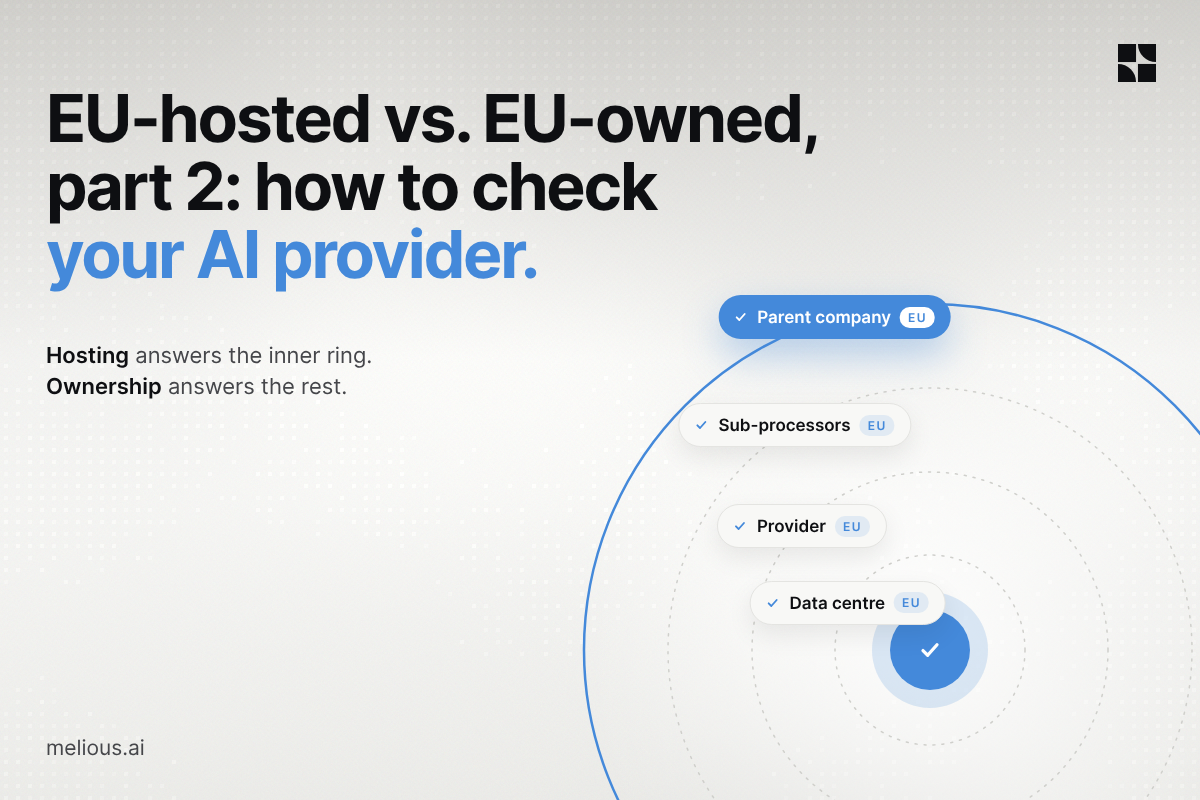
In short: A server in Frankfurt doesn't make your AI provider European. What counts is whether every company that touches your requests is, because that decides whether laws like the US CLOUD Act can reach your data. Here's how to check it in six steps, ending with seven questions to send any provider before you sign.
Your AI provider's servers are in the EU. Good. But in part 1 we showed why that's only half the answer: the US CLOUD Act follows control, not location. This part is about the other half, and how to check it.
This matters on both sides of a deal. If you buy AI services, it decides what you can tell your data protection officer. If you sell software with AI features to European companies, it's increasingly a line in the security questionnaire: not only "where is the data processed?" but also "whose law can reach it?"
This article is general information, not legal advice. For decisions about your own data processing, talk to your data protection officer or legal counsel.
Step 1: Know what you're sending
Start with the cheapest fix: send less. If a support bot only needs the text of a ticket, strip names, emails and customer IDs before the API call. For contracts, consistent placeholders often work just as well as real party names. Keep the mapping on your side, so the real names never end up in a prompt or a log.
Minimisation has limits, though. Sometimes the prompt itself is the sensitive part: source code, internal documents, strategy papers. You can't remove the identifying parts without making the model useless. And agents pull in context on their own, so you often don't know exactly what ends up in a call.
So do both: minimise what you can, and choose a provider where the rest isn't within reach of non-EU laws. The next steps are about the second part.
Step 2: Place the provider in one of four boxes
Hosting and ownership are independent of each other, so every provider lands in one of four boxes:
- EU-hosted and EU-owned: European company, European data centres. Both questions answered.
- EU-hosted, but not EU-owned: A US provider's EU region or "sovereign cloud". The data stays in the EU, but a US parent sits in the chain.
- EU-owned, but partly hosted outside the EU: A European company that sends some requests to capacity outside Europe, for example when its own runs out.
- Neither: a non-European company with data centres outside the EU.
Most confusion comes from box 2. The data never leaves Europe, so it feels safe, but the company that controls it can still receive an order from outside the EU. Box 3 is the mirror image, and it's easy to miss: the company is European, but some of your requests aren't.
Only box 1 answers both questions. The rest of this guide is about finding out, with evidence, whether a provider really sits there.
Step 3: Read the labels for what they leave out
Vendor pages use a handful of labels. Each one answers one question well and stays silent on the other.
- "EU data residency" usually means that data is stored and processed in EU data centres. It doesn't tell you who owns the company or its parent.
- "Sovereign cloud" usually means EU-based operations, often through a separate EU entity with EU-resident staff. It doesn't tell you whether a non-European parent still controls that entity. Definitions vary by vendor.
- "GDPR-compliant" or "GDPR-ready" usually means the vendor offers the contracts and measures the GDPR requires. It doesn't tell you where the data is, or who can be ordered to hand it over.
- "European company" usually means the contracting entity is registered in Europe. It doesn't tell you who owns it. A European GmbH can be fully owned by a US parent, as we showed in The German GmbH That Belongs to Delaware.
- "EU-only routing" usually means requests can be restricted to providers in the EU. It doesn't tell you whether that's the default, or a setting someone has to switch on.
- "EU data zone" (for example on a US cloud's AI service) usually means requests are processed in EU regions of that cloud. It doesn't tell you anything about jurisdiction: the provider is still a US company, so the CLOUD Act still applies.
None of these labels is dishonest. But if a page only gives you labels, you only have half the answer.
Step 4: Find the company you sign with, and who owns it
Start with the contract, not the marketing page. The terms of service, the data processing agreement (DPA) and the legal notice name the company you actually have a relationship with. Check what kind of company it is and where it is established.
A European address is not the end of it. Look for a parent company. Company registers help here: in Germany, for example, the Handelsregister publishes a GmbH's list of shareholders. If a shareholder is itself a company, repeat the check for that company. For larger groups, the annual report usually names the parent.
What matters is control. If a non-European parent controls the entity and the data it holds, the provider may fall under that parent's jurisdiction. Ownership can also change, for example in a funding round, so ask how the provider would tell you.
Step 5: Trace one request through the stack
AI stacks usually involve more companies than a normal cloud service. Take one real request, for example a support ticket your chatbot summarises, and follow it from start to finish:
- The tool you send it from: your app, a coding assistant, a workflow tool
- The gateway or router, if there is one, that decides where the request goes
- The inference provider that runs the model
- The data centre or cloud where that hardware sits
For each step, write down two things: the country of the data centre (hosting) and the country of the company and its parent (ownership). A European company can still route your request to a US-owned cloud region, and a US router can send it to a European data centre. One non-EU owner anywhere in the chain is enough for its jurisdiction to matter, even if every server is in Europe.
Two places need extra attention:
- The gateway step. If a gateway or router sits in between, check which providers it can send your request to, where those providers are established, and which of them your account actually uses.
- The failure case. Ask what happens when the provider's own capacity runs out or a location goes down. That's where requests most often leave the box you thought you were in.
You don't have to take the vendor's word for most of this. Under the GDPR, a provider needs your authorisation before it lets other companies, its sub-processors, handle your data, and it has to tell you before it adds new ones. That's why they are usually listed in the DPA. Go through that list line by line: for each sub-processor, check where it is established and, if it isn't obvious, who owns it. It is the closest thing you'll get to a map of the stack.
If you're the vendor: list the LLM API behind your AI features as a sub-processor (many teams forget it), and add the parent company and its jurisdiction next to every sub-processor. It answers the ownership question before the buyer asks it and saves a round of follow-up questions.
Step 6: Ask these seven questions
Send these to any AI provider before you sign. A good provider answers them in writing, in a few lines each.
- Which legal entity do I sign with, where is it established, and who owns it? Check the company register if the answer is vague.
- Which sub-processors handle my requests? Ask for the list and check where each company is established, not only where its servers are.
- Where is the hardware, and who operates it?
- If your own capacity fails or runs out, where do requests go?
- Is EU-only processing the default, or a setting? A setting is only as reliable as the person who has to remember to switch it on.
- Are prompts and responses stored or logged, and is my data used for training? Get the answer in the DPA, not only on the marketing page.
- What happens if a foreign authority requests my data? Does the provider commit in writing to telling you, and what else does it promise to do?
If a provider can't answer these clearly, treat that as an answer.
How Melious answers them
It would be too easy to set this test and not take it ourselves. Every answer below can be checked against our DPA and our legal notice.
- Legal entity and owner: Melious AI GmbH, Saarbrücken, Germany, registered at the Amtsgericht Saarbrücken under HRB 111794. Our shareholder list is public in the Handelsregister.
- Sub-processors: 16, listed with address, service and country in Annex 4 of our DPA. All of them are established in an EU country and provide their service there. We announce new ones at least three weeks in advance, and you can object.
- Hardware: European data centres only, operated by the companies in our DPA. Part of it is dedicated hardware reserved for us at OVHcloud in France and Verda in Finland, marked as such in Annex 4.
- Failure case: If a provider fails, requests move to another provider in our DPA, so they stay in the EU.
- Default or setting: Default. There is no non-European route to switch on.
- Storage and training: We don't log the content of prompts or responses, only operational metadata such as token counts, model and timestamps, and we never train on customer data. Inference providers don't receive your user ID or your API key. Files and batch jobs you choose to store stay, encrypted, until you delete them.
- Foreign requests: If anyone tries to access your data through a seizure or an official order, we tell you unless a court or authority order prohibits it, and we make clear that the decision over the data is yours. Since we don't log prompts or responses, there is no record of your normal API requests to hand over. The only content we hold is what you store yourself, such as files and batch jobs, and you can delete it at any time.
If the answers you get from your current provider mean you need to move, our guide on how to switch from a US AI provider to EU inference walks you through it step by step. Our API speaks both the OpenAI and the Anthropic format, so in most cases you change a base URL and keep your code.
Run the check on us
Read our DPA and its sub-processor list, then try the API with your own tools. Claude Code, Cursor and LangChain work once you change the base URL.
Frequently asked questions
How can I check whether an AI provider is EU-owned?
Find the legal entity you sign with, then check who owns it, for example in the company register. Then ask for the list of sub-processors and check where each one is established. EU-owned means every company in that chain is European.
Which AI platforms guarantee no foreign authority access to data?
No provider can promise that no authority anywhere will ever ask for data. What you can choose is the jurisdiction. A provider that is established in the EU, has no non-European parent, uses only European sub-processors and isn't otherwise subject to US jurisdiction is generally outside the reach of the US CLOUD Act. The seven questions above help you check this.
What is a sub-processor, and why does it matter?
A sub-processor is another company your provider uses to handle your data, such as a cloud or inference partner. Under the GDPR, your provider needs your authorisation to use them and has to tell you about changes, which is why they are usually listed in the DPA. If any of them is non-European, your data can be exposed to non-European law, even if your provider itself is European.
What if a provider won't share its sub-processor list?
Then you can't check the chain, and that is a risk in itself, regardless of where its servers are. Under the GDPR you are entitled to know who processes your data on the provider's behalf.
Is a European gateway enough?
Not on its own. A gateway decides where your request goes. If it can route to a US-owned provider, that provider's jurisdiction applies to the requests it handles. Check the providers behind the gateway, not just the gateway.
Does "EU-only routing" mean my data never leaves Europe?
Only for the requests it covers. Ask whether it applies to your account by default and what happens when European capacity runs out.
Is "sovereign cloud" the same as EU-owned?
No. Sovereign cloud offerings keep data and operations in the EU, often through a separate EU entity, but several of them are owned by US companies. Check who owns the entity behind the offering.
Is Azure OpenAI's EU Data Zone EU-owned?
No. An EU data zone keeps processing in EU regions, but Microsoft is a US company, so the CLOUD Act still applies to data it controls. It answers the location question, not the jurisdiction question.
Can't I just anonymise data before it reaches the model?
Partly, and you should. Removing names and IDs from tickets or using placeholders in contracts reduces what's at stake. But for code, internal documents and agent workflows, the sensitive part is often the content itself, so minimisation alone won't cover it.
Do European providers have good enough models and capacity?
For many B2B tasks, yes: open-weight models such as Qwen, DeepSeek, GLM or Mistral run on European infrastructure today and handle most text, coding and agent work well. For the latest closed models, such as GPT or Claude, you still need their US makers. Test on your own workloads, and ask any provider how it handles outages and capacity limits.
Do I have to repeat this check?
Yes, from time to time. Sub-processors, ownership and routing can change. A provider has to inform you about new sub-processors, and it's worth checking the list again before you expand your use.
Further reading
- EU-hosted vs. EU-owned: why your AI provider's jurisdiction matters as much as its data centre (part 1)
- The German GmbH That Belongs to Delaware
- The Data Privacy Framework holds. That is not the same as safe.
- GDPR, Article 28: Processor (rules on sub-processors)
- US Department of Justice: CLOUD Act resources, including the full text
- Melious data processing agreement (DPA)