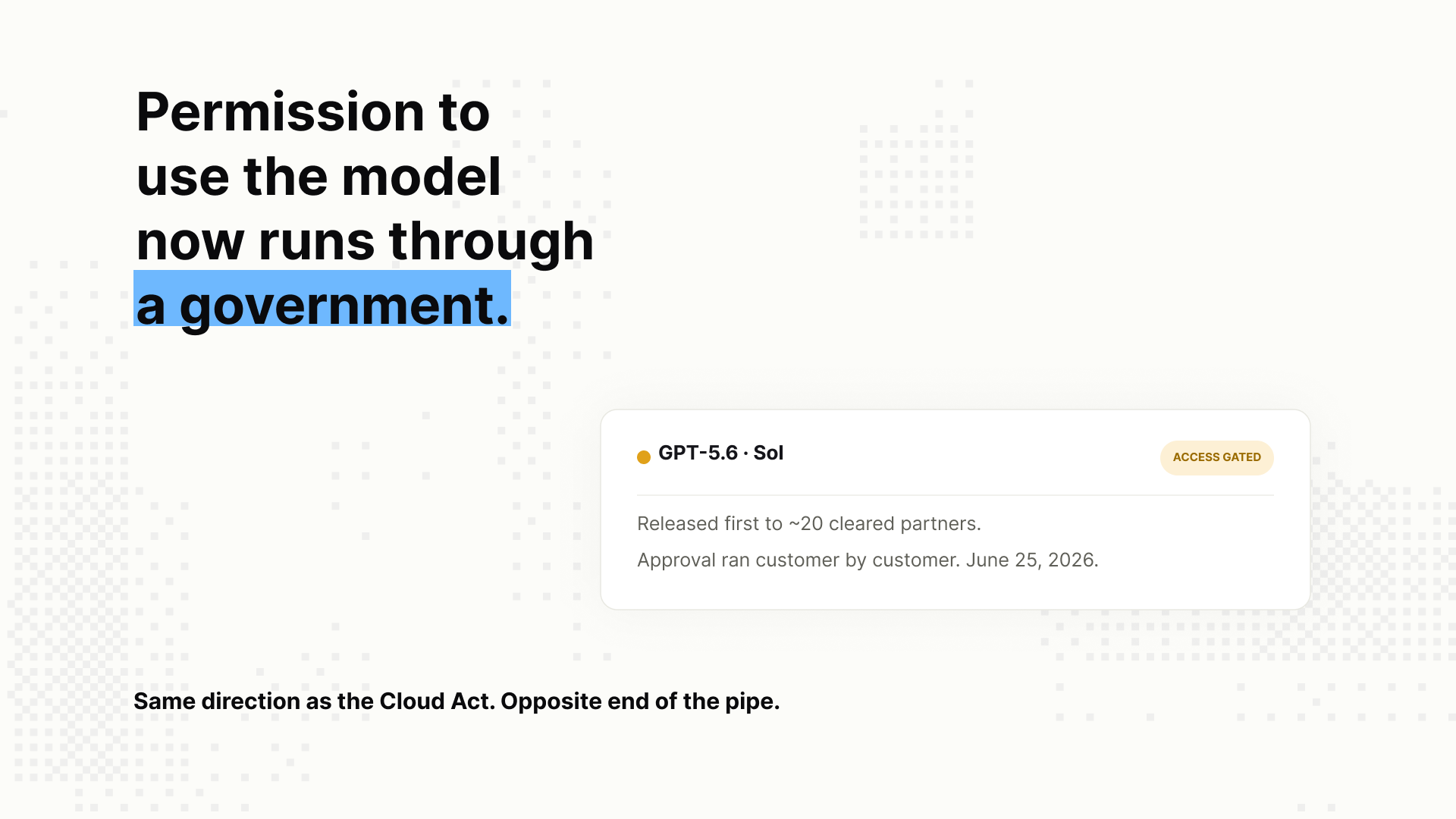
On June 25, The Information reported that OpenAI would not release GPT-5.6 to the public the way it released earlier models. Instead, the model goes to a small set of partners first, and the reason is not technical. The Trump administration asked for it.
According to the report, CEO Sam Altman told staff that the government would be approving access "customer by customer" during a preview period. Two federal offices were named: the Office of the National Cyber Director and the Office of Science and Technology Policy. If the limited rollout goes well, a broader release might follow a couple of weeks later.
Read that sentence again. A government office signs off on who gets access to a commercial AI model, one customer at a time.
This is not a one-off
Three weeks earlier, on June 2, the administration signed an executive order directing certain AI companies to submit new models to the government for testing before public release. OpenAI is the first big test of what that looks like in practice.
It also mirrors what Anthropic already does on its own. Its frontier cyber model, Claude Mythos, shipped only to a small group of partners through a program called Project Glasswing. The stated reason was that the model was too capable to release widely, since a frontier cyber model can find and exploit software vulnerabilities faster than any human analyst.
You can debate whether that caution is sincere or convenient. That debate misses the part that matters for anyone building on these models.
Availability is now a political variable
For most of the last three years, the question with a closed model was commercial: what does it cost, what are the rate limits, when does the old version get deprecated. Those were hard enough to plan around. We wrote about that when OpenAI retired GPT-4o and forced everyone built on it to migrate.
GPT-5.6 adds a new variable on top. Not "can I afford this model" but "am I on the list this month." When a US government office approves access customer by customer, your roadmap depends on a decision made in Washington, about priorities that are not yours, on a timeline you do not control.
For a European company, that variable compounds. You are not the constituency these offices answer to. If access gets staggered, paused, or scoped to certain partners or certain regions, you find out when you find out. You build around it after the fact.
This is the same mechanism we saw earlier this month when a US export control directive forced Anthropic to suspend Fable 5 and Mythos 5 for foreign nationals. Different trigger, same shape. A decision inside the US system changed what a company outside it was allowed to use, overnight, with no say from the people affected.
What does not have this switch
Open-weight models work differently, and the difference is structural, not rhetorical.
When you run an open-weight model like Llama, Qwen, Mistral, or DeepSeek, you hold the weights. No preview list. No customer-by-customer approval. No federal office between you and the model you already deployed. A government can change what a US lab is allowed to ship next quarter. It cannot un-ship the weights you are already running.
Hosting matters just as much as the license. An open-weight model running on US infrastructure still sits under US jurisdiction. The sovereignty argument only closes when the weights are open and the compute is under EU law. That is the combination Melious is built on: open-weight models, hosted entirely on European infrastructure, data under EU jurisdiction, no US government access path.
The take
The GPT-5.6 rollout is a small story with a large implication. It shows, in plain terms, that access to the most capable closed models is now something a government can gate. If your stack depends on those models, that gate is part of your stack whether you planned for it or not.
The teams least exposed to this are the ones whose models cannot be recalled, gated, or staggered by a decision they were never part of. That is not a patriotic argument. It is an operational one.
Building on infrastructure you control
Melious runs open-weight models on European infrastructure, behind one OpenAI- and Anthropic-compatible API. Data stays under EU law.